Tomb of the Mask: Old Maze
- 4.3
- Rating
- 100.00M
- Installs
- Free
- Price
 Analysis by App-foxy
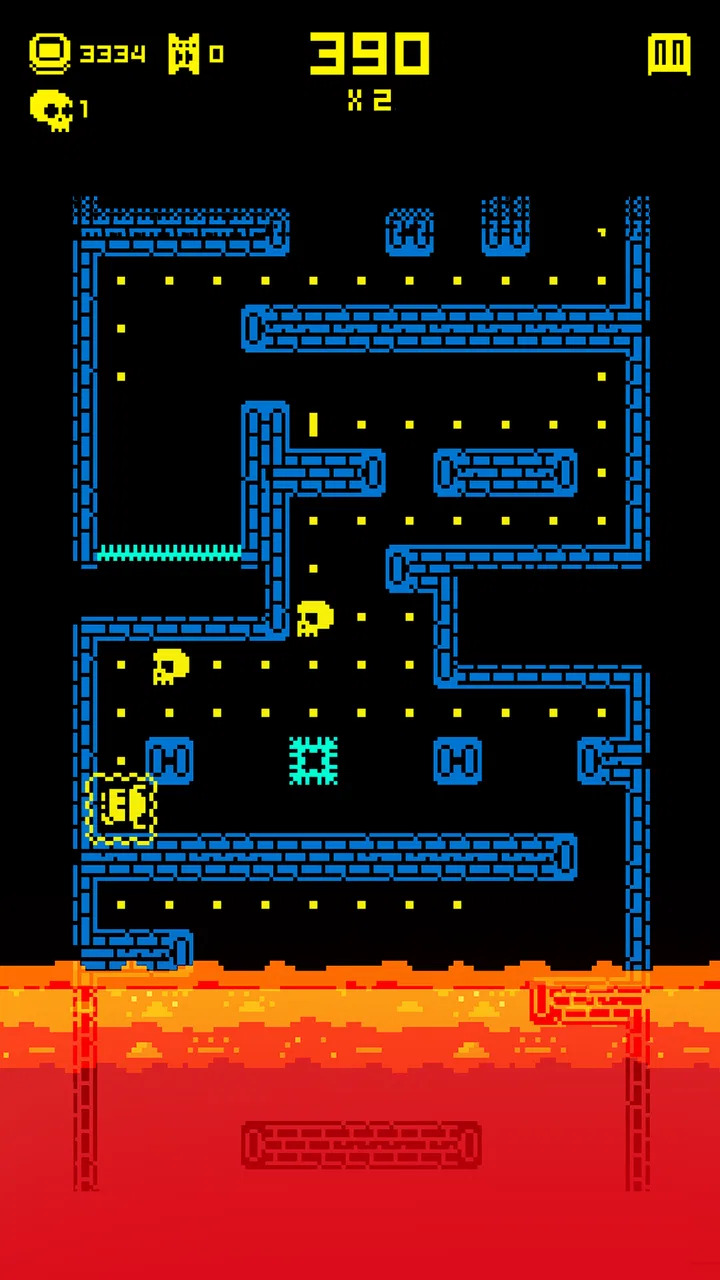
I first approached Tomb of the Mask: Old Maze expecting a quick arcade distraction, and that is exactly where it fits best. It is an action game built around moving through compact pixel mazes, avoiding traps, and reacting before the next mistake becomes unavoidable. The controls are simple enough to understand immediately, but the timing becomes demanding surprisingly quickly. I found myself beginning with short sessions and then replaying the same kind of challenge because I knew I could improve my route.
That combination explains why the game has reached over 100 million installs and holds a 4.3 average from around 2.5 million ratings. Those numbers do not make every player a perfect match, but they do reflect how accessible the central idea is. The game is free to start, rated Everyone, and developed by Playgendary Limited. It is available for devices running Android 7.0 or later, with the current version listed as 1.24.1.
How the maze loop feels in everyday play
The basic routine is wonderfully direct. I enter a maze, move through its corridors, avoid hazards, and try to stay calm when the available path narrows. There is no long tutorial to study before the game makes sense. The first few attempts teach the important lesson: movement is easy to begin, but stopping at the right moment and choosing the next direction are what separate a clean run from a restart.
You May Also Like

 AccuWeather: Weather Radar
AccuWeather Review: A Quick, Clear Forecast for Everyday Decisions
For everyday plans, the best forecast is the one you can understand quickly. AccuWeather makes rain timing, radar, and local conditions easy to act on, with a few trade-offs.

 Hill Climb Racing
Why Hill Climb Racing Still Turns Crashes Into One More Run
A tiny car, a bumpy hill and one more upgrade: Hill Climb Racing keeps resurfacing because its simple chaos makes every near-miss feel personal.

 AliExpress - Shopping App
AliExpress Makes Global Shopping Feel Personal, but Shoppers Bear the Risk
AliExpress turns a global marketplace into a pocket-sized discovery engine. Its reach is useful, its shopping loop compelling, and its trade-offs easy to miss.

 Lords Mobile: Kingdom Wars
Lords Mobile Is a Kingdom-Building Routine, Not a Quick Match
A case-by-case verdict on the building, battles, device demands, and social commitments that make Lords Mobile rewarding for some players and exhausting for others.

 PDF Scanner app - TapScanner
TapScanner Makes Paperwork Easier to Capture, Check, and Share
TapScanner makes scanning with a phone feel less like a rescue operation and more like a dependable step in getting work done. Its capture tools are useful, though not flawless.

 Block Blast!
 Shows How Much a Puzzle Game Can Leave Out
A quiet grid game shows why puzzle players increasingly value instant clarity, repeatable skill and low-pressure play—and where the genre still needs to catch up.
More From Our News Desk
View All News


I like using it in situations where I have only a few minutes, such as waiting for an appointment or taking a short break between tasks. A single attempt has a clear beginning and end, so I do not need to remember a complicated story or manage a large inventory. At the same time, the quick format can become a trap of its own. A failed run often feels close enough to success that I immediately try again, which can turn a five-minute break into a much longer session.
The pixel presentation supports that rhythm well. The visual style is clear rather than elaborate, and the maze remains the focus. I can usually understand the shape of the immediate route without the screen becoming visually noisy. That matters in a game where hesitation is often more damaging than a lack of knowledge. The old-school appearance also gives the experience a distinctive character compared with glossy action games that rely on large effects and constant spectacle.
My normal workflow is to make one exploratory attempt, then stop treating the maze as a surprise. On the next try, I pay attention to the order of turns, the position of traps, and the places where I tend to rush. This small change makes the game feel less like random reflex testing and more like a repeatable practice exercise. I am not simply asking whether I can survive; I am asking which decision caused the failure.
That approach is especially useful for players who enjoy arcade games with short feedback loops. You fail, understand a little more, and immediately have another chance to apply the lesson. It is less satisfying for someone who wants a relaxed puzzle game where every move can be considered without pressure. The maze format may look like a traditional logic challenge, but the action timing means the experience is much closer to an arcade test of attention.
What I check before settling into a session
Because the game is free, I would install it with the expectation that the experience may include optional purchases. The listed in-app purchase range runs from $0.99 to $139.99 per item, so I would review the purchase controls on the device before handing it to a child. The Everyone rating makes it broadly approachable from an age perspective, but age suitability and spending suitability are not exactly the same thing.
I also check whether the device is comfortable for quick directional input. A small screen is not automatically a problem, but cramped touch controls can make a precise turn feel less reliable. I prefer holding the phone securely and keeping my thumb ready for the next swipe rather than playing one-handed while walking or carrying something. This is a small practical habit, yet it reduces accidental inputs more than I expected.
The game does not need a complicated preparation routine, but I still avoid beginning a serious attempt when notifications are constantly appearing. A brief interruption can break the visual rhythm, especially when I am already planning the next two turns. For casual play, that hardly matters. For players chasing cleaner runs, a quiet screen and a stable grip are more valuable than any elaborate strategy.
I would also decide in advance whether I am playing for discovery or repetition. During discovery, I accept that I will make mistakes while learning the route. During repetition, I use the same opening movements until they become automatic. Mixing those two mindsets can be frustrating: I may take unnecessary risks while trying to improve a section that I have not properly understood yet.
One useful habit is to pause mentally after a failure instead of instantly blaming the controls. I ask whether I turned too early, reacted too late, or entered a corridor without a safe exit in mind. Sometimes the answer really is an awkward input, but often the underlying problem is that I committed to a route before reading the next section. This distinction helps me improve instead of repeating the same mistake faster.
Patterns that make repeated attempts more efficient
The most effective improvement I found was to divide each maze into small decisions rather than trying to memorize everything at once. I focus first on the opening, then on the first dangerous transition, and finally on the section where my run usually collapses. Once the opening becomes dependable, I have more attention available for the difficult part. This is more efficient than restarting with a vague hope that the entire route will suddenly feel familiar.
I also learned not to treat speed as the only measure of success. A fast movement that leaves me badly positioned for the next turn is usually worse than a slightly more deliberate choice. The game rewards forward momentum, but momentum without planning creates predictable failures. My best runs are not necessarily the ones where every input is rushed; they are the ones where each movement leaves a useful option open.
When I reach a section with several possible directions, I look for the route that gives me the clearest next decision rather than the route that merely appears shortest. This is an important trade-off. A shorter path can be attractive, but if it forces a blind reaction immediately afterward, it may be harder to execute consistently. A longer-looking route can be better when it gives me more time to read the maze and prepare.
Another practical technique is to use failed attempts as route notes without writing anything down. I remember one landmark or turn that caused trouble, then concentrate on reaching that point cleanly in the next attempt. This creates a series of small targets. It also prevents the common arcade-game mistake of thinking about the final goal while ignoring the hazard directly in front of me.
For short daily sessions, I prefer setting a process goal instead of a vague score goal. I might decide to reach a familiar section without repeating an early mistake, or to make a particular transition with more control. Process goals keep the game enjoyable when progress is incremental. They also reveal whether I am genuinely learning the maze or simply relying on luck.
Players who are comfortable with touch-action games may notice that the challenge changes as soon as the first few movements become automatic. At that point, the main difficulty is not understanding what to do, but maintaining attention through repetition. I find that taking a short break after several failed attempts is better than forcing another run while annoyed. Frustration encourages hurried swipes, and hurried swipes hide the actual lesson in the failure.
Where the simple design reaches its limits
The focused design is also the game’s main limitation. If I want a large campaign, character development, deep equipment choices, or a story that carries me from one session to the next, this is not the right choice. The appeal comes from the maze itself and from improving execution. Players who need constant novelty may find the repeat-and-refine structure too narrow after the initial excitement fades.
The free entry point is convenient, but optional purchases can affect how comfortable the game feels for different players. I am happy to treat the game as a casual arcade title and ignore spending, but someone who dislikes any purchase prompts may find that model distracting. Families should also use the device’s purchase protections, particularly because the highest listed individual purchase is substantial compared with the cost of a typical impulse buy.
Another limitation is that precision depends heavily on attention and touch confidence. This is not a game I would recommend as a relaxing activity for someone who dislikes quick reactions. It can also be a poor fit when playing in a moving vehicle, in a noisy queue, or while multitasking. The controls may be easy to learn, but the timing still asks for concentration.
Compared with conventional puzzle games, it gives me less time to analyze a route. Compared with endless runners, it gives me more of a sense that my failures are caused by decisions I can correct. Compared with larger action games, it is much lighter on content and commitment. That middle position is important: it is more thoughtful than a purely reflexive distraction, but less expansive than a full adventure or action campaign.
I would skip it if my priority were offline-style relaxation, long narrative sessions, or a generous control scheme that forgives hesitation. I would also look elsewhere if I wanted multiplayer competition or a rich collection of modes, since the central maze loop is the reason to stay. On the other hand, I would recommend it to someone who enjoys replaying compact challenges and appreciates games where a better result usually comes from better habits.
The listed release date is June 19, 2018, and the current version is 1.24.1. For me, the more important point is that the game still makes sense as a self-contained arcade experience: I can understand it quickly, practice specific moments, and put it down without losing a complicated thread. That simplicity is a strength, although it also means the game has to hold my attention through execution rather than through a broad collection of systems.
My verdict after treating it like a skill game
After playing it with a more deliberate routine, I see Tomb of the Mask: Old Maze as a strong pick for quick action sessions and a weaker pick for players seeking depth outside the maze. Its best quality is the clarity of its challenge. When I fail, I can usually identify a rushed decision, a poor route choice, or a lapse in attention. That makes another attempt feel meaningful rather than arbitrary.
I would recommend starting without spending anything, learning how the movement feels on your device, and deciding whether the repeatable arcade loop suits you. If it does, the game offers plenty of room to improve through route reading, controlled timing, and consistent habits. If it does not, more attempts will not transform it into a traditional puzzle adventure; its identity is firmly tied to quick movement through dangerous pixel mazes.
My strongest advice is to play with a specific purpose. Explore first, practice one troublesome section second, and only then worry about completing a cleaner run. Keep your hands steady, remove distractions when you are trying to improve, and use the game’s short sessions to your advantage rather than chasing endless retries. The real strength is not simply escaping a maze, but learning to make the same movement reliably under pressure.
For a free action game with an Everyone rating and broad device support from Android 7.0 onward, it is easy to try and easy to understand. The purchase range, quick-failure structure, and demand for concentration are the main points I would consider before recommending it to a child or to someone who prefers calm games. For me, though, the balance works: it is compact, distinctive, and satisfying when I approach each attempt as practice instead of just another attempt to get lucky.
FAQs for Tomb of the Mask: Old Maze
01What is the main objective of Tomb of the Mask: Old Maze?
Tomb of the Mask: Old Maze is a fast-paced arcade game where the primary objective is to navigate through procedurally generated mazes, collecting dots and power-ups while avoiding traps and enemies. The game's unique selling point is its retro aesthetic combined with modern gameplay mechanics, offering a fresh yet nostalgic experience.
02Is Tomb of the Mask: Old Maze suitable for children?
Yes, Tomb of the Mask: Old Maze is suitable for children. The game features colorful graphics and simple controls, making it accessible to younger players. However, it does involve quick decision-making and strategic thinking, which can be a great way for kids to improve their cognitive skills while having fun.
03Are there any in-app purchases in Tomb of the Mask: Old Maze?
Yes, Tomb of the Mask: Old Maze includes in-app purchases. Players can buy various items, such as additional lives, power-ups, or cosmetic upgrades for their character. These purchases are optional, and the game can be enjoyed fully without spending money, but they can enhance the overall gaming experience.
04How does the control system work in Tomb of the Mask: Old Maze?
The control system in Tomb of the Mask: Old Maze is intuitive and designed for touchscreen devices. Players swipe in the direction they want their character to move, and the character continues in that direction until an obstacle is encountered. This simple control scheme allows for quick, responsive gameplay that keeps players engaged.
05Can Tomb of the Mask: Old Maze be played offline?
Yes, Tomb of the Mask: Old Maze can be played offline, making it perfect for gaming on the go without requiring an internet connection. However, certain features, such as leaderboards or some in-app purchases, may require connectivity to access fully. This offline capability ensures uninterrupted gameplay anytime, anywhere.
Pros
- Fast-paced and engaging gameplay.
- Colorful
- retro-style graphics.
- Simple controls
- easy to learn.
- Daily challenges for rewards.
- Offline play available.
Cons
- Ads can be intrusive.
- Repetitive level design.
- In-app purchases can be pricey.
- Limited storyline depth.
- Occasional lag in gameplay.

Tomb of the Mask: Old Maze
Gallery